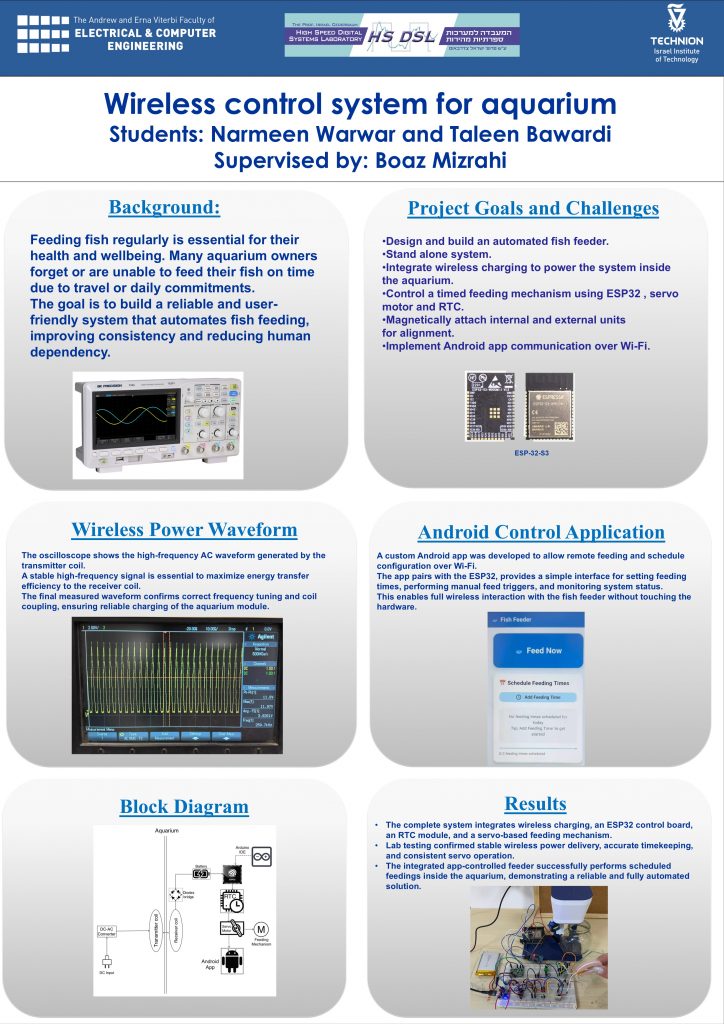
This project presents a wireless-controlled smart fish feeder that enables automated feeding without external wiring using wireless power transfer and an ESP32 controller.
The rapid growth of smart and connected systems has increased the demand for reliable automation solutions in everyday environments, including home aquariums. Traditional automatic fish feeders often rely on wired power connections, which can be inconvenient, limit placement flexibility, and pose safety concerns in humid or submerged environments. This project addresses these challenges by developing a wireless-controlled smart fish feeder that operates without external wiring while maintaining reliable power delivery and precise control.
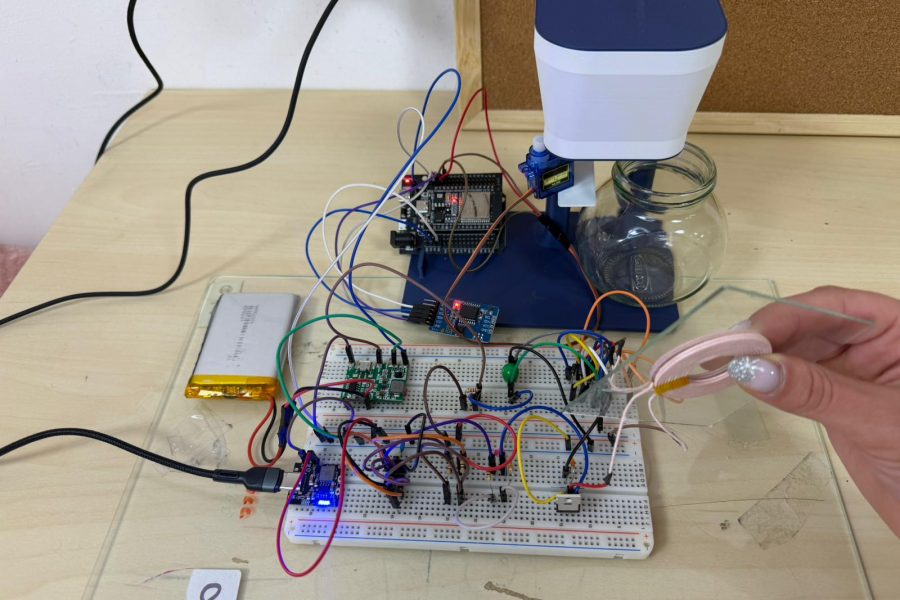
The proposed system is based on a wireless power transfer architecture that supplies energy to an internal feeding mechanism located inside the aquarium. A dedicated transmitter generates an alternating electromagnetic field, which is received and converted into usable electrical power on the receiver side. This power is then used to operate an ESP32 microcontroller, a real-time clock (RTC), and a servo motor responsible for dispensing food. The use of wireless power significantly improves system safety and flexibility, allowing the feeder to be fully enclosed and easily positioned within the aquarium.
Control and configuration of the system are achieved through a Wi-Fi connection between the ESP32 and a mobile application. The application enables the user to configure network settings, schedule feeding times, and manually trigger feeding operations when required. The RTC ensures accurate timekeeping and consistent feeding schedules even when network connectivity is temporarily unavailable. The servo-based dispensing mechanism provides controlled and repeatable food release, minimizing overfeeding and maintaining stable feeding routines.
Experimental evaluation of the prototype demonstrates stable wireless power transfer, reliable communication, and accurate timed operation of the feeding mechanism. The system operates continuously under realistic conditions and responds correctly to both scheduled and user-initiated commands. The results confirm that the proposed design is a practical and scalable solution for aquarium automation and highlights the potential of wireless power transfer combined with embedded control for smart home and IoT applications.