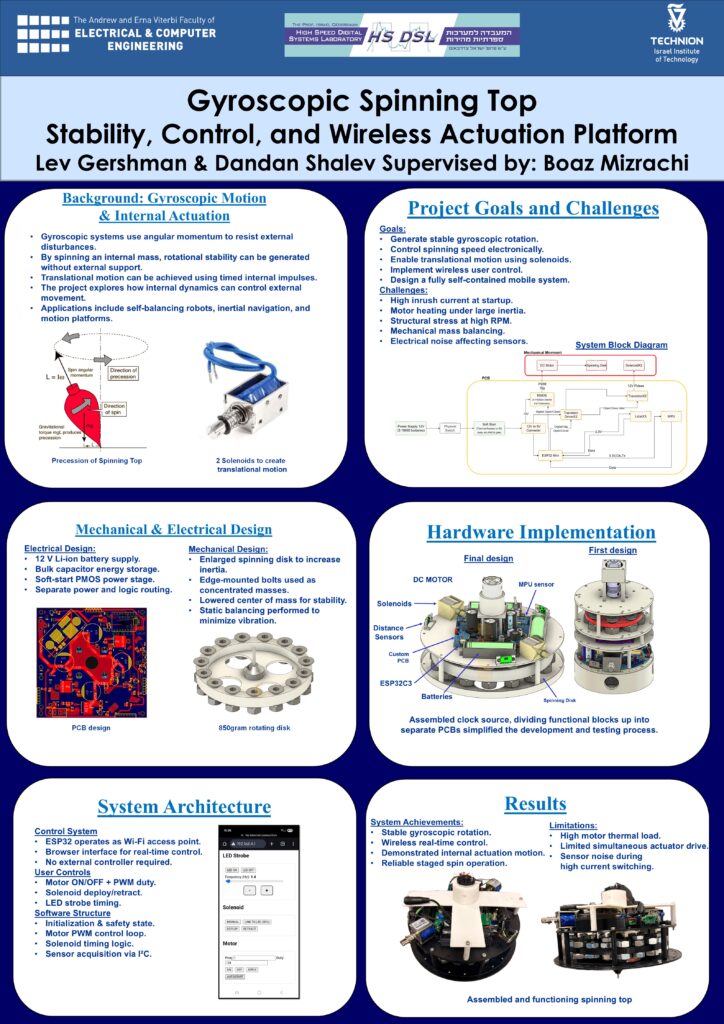
This project presents the design and implementation of a self-contained gyroscopic spinning top that generates rotational and translational motion using internal actuators. The system integrates mechanical redesign, power management, motor control, and wireless operation to achieve stable, repeatable spinning behavior under real-world constraints.
This project focuses on the development of an internally actuated gyroscopic spinning top designed to demonstrate controlled rotational motion and experimentally explore the interaction between mechanical inertia, power delivery, and embedded control. The system builds upon an initial proof-of-concept prototype and evolves it into a more robust, reliable, and well-documented platform suitable for continued academic development.
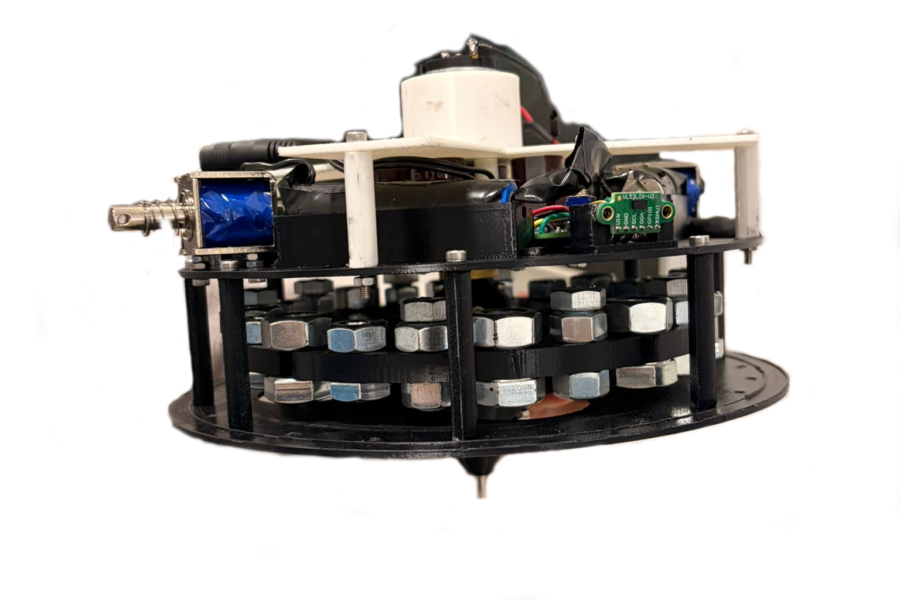
The spinning top generates angular momentum using an internally driven rotating mass powered by a DC motor, while translational motion is produced through symmetrically mounted solenoids. To improve gyroscopic stability, the mechanical design was significantly revised by increasing both the mass and diameter of the spinning disks, resulting in a substantial increase in moment of inertia. The overall system height was reduced to lower the center of mass, further enhancing stability during free spinning. Static mass balancing techniques were applied to minimize vibration and align the center of gravity with the rotational axis.
Several electrical and power-related challenges were encountered during development. High inrush current caused unreliable startup behavior, which was resolved through the introduction of a soft-start circuit on the main 12 V power rail. Pulse-width modulation (PWM) was implemented to enable adjustable DC motor speed, allowing controlled spin-up of the internal disks. During testing, it was observed that simultaneous operation of the DC motor and solenoids exceeded the battery’s current limits and caused significant motor heating. As a result, a staged operational strategy was adopted, in which the motor is used only to accelerate the internal mass while the chassis is held stationary. After the motor is turned off, angular momentum transfer causes the outer chassis to spin, enabling stable operation of the solenoids without exceeding power limits.
The system is controlled by an ESP32-C3 microcontroller, which provides motor control, solenoid actuation, sensor communication, and wireless connectivity. A Wi-Fi–based user interface allows remote control of motor speed and solenoid timing. PCB layout considerations played a critical role in system reliability, leading to revisions that improved signal integrity, reduced electromagnetic interference, and ensured balanced mass distribution across the rotating electronics.
Experimental results demonstrate stable spinning behavior lasting approximately 50 seconds, with clear acceleration, peak stability, and decay phases observed through video-based rotational analysis. While closed-loop stabilization was not implemented, the project successfully highlights key trade-offs between mechanical performance, power availability, thermal limits, and structural integrity. The final system represents a complete transition from prototype to a well-characterized and extensible experimental platform.