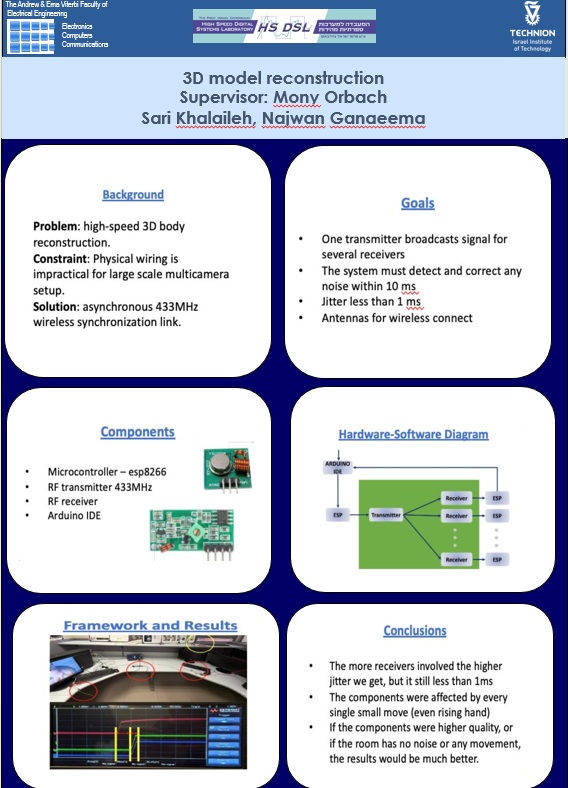
This project presents a wireless multi-camera synchronization system designed a real time 3D body reconstruction. In the project level there are microcontrollers and RF modules work at 433MHz frequency. The system achieves triggering across multiple receivers (up to 10) with measured jitter up to 80 microseconds, significantly outperforming the threshold of 1 millisecond.
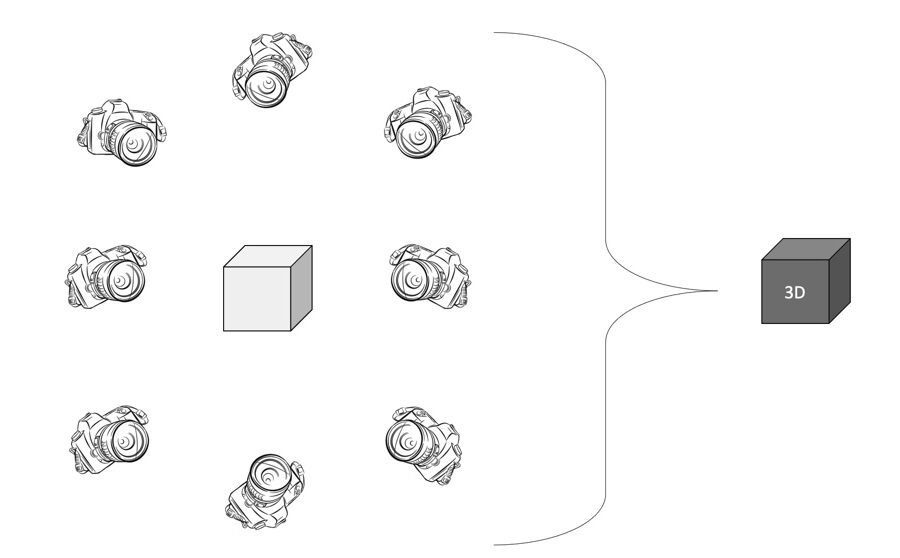
In such systems, high precision image capturing from multiple angles is essential to ensure consistency of reconstructed 3D model of an object, particularly when the body is in motion. This project addresses the challenge of temporal synchronization wirelessly, while traditional wired synchronization provides stability, it also introduces logistical constraints. Consequently, this project develops efficient wireless alternative utilizing a single transmitter and an array of receivers that are relatively cheap. The hardware architecture built upon esp8266 NodeMCU platform, interfaced with 433MHz radio frequency transmitter and receivers. The implementation leverages hardware interrupt capabilities of the Arduino IDE and esp to induce timing uncertainties. Two primary communication algorithms were investigated: a basic Pulse Width Modulation- PWM and a specialized Char based serialization algorithm. The first one was found to be superior in mitigating environmental noise/distortion and improving signal integrity across the wireless links.
Experimental results conducted within the High Speed Digital Systems Laboratory (HSDSL) demonstrate that the system maintains exceptional timing stability. Tests involving up to 3 receiver configuration showed synchronization jitter ranging between 20 microseconds and 80 microseconds at distances up to 4 meters. These results represent a success, as the timing deviation remains well below the project’s 1 millisecond requirement. The project concludes that the integration of low cost RF components with optimized interrupt driven software provides a robust and scalable solution for multi camera synchronization, laying the groundwork for more complex high speed digital communication infrastructure.