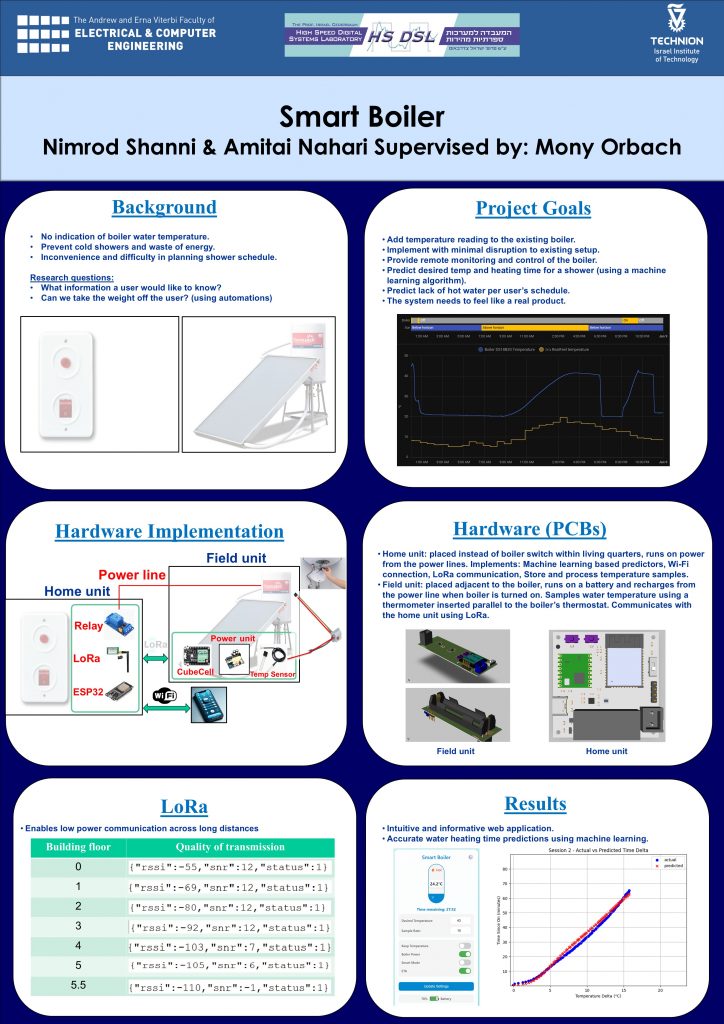
Smart Boiler is a two-part system that monitors and predicts hot water availability while optimizing energy usage. It integrates a LoRa-connected field unit at the boiler with a home unit inside the house, supported by a machine learning heating-time predictor and a usage predictor, which predicts when the next shower is expected, and alerts the user if turning on the boiler is necessary to ensure sufficient hot water.
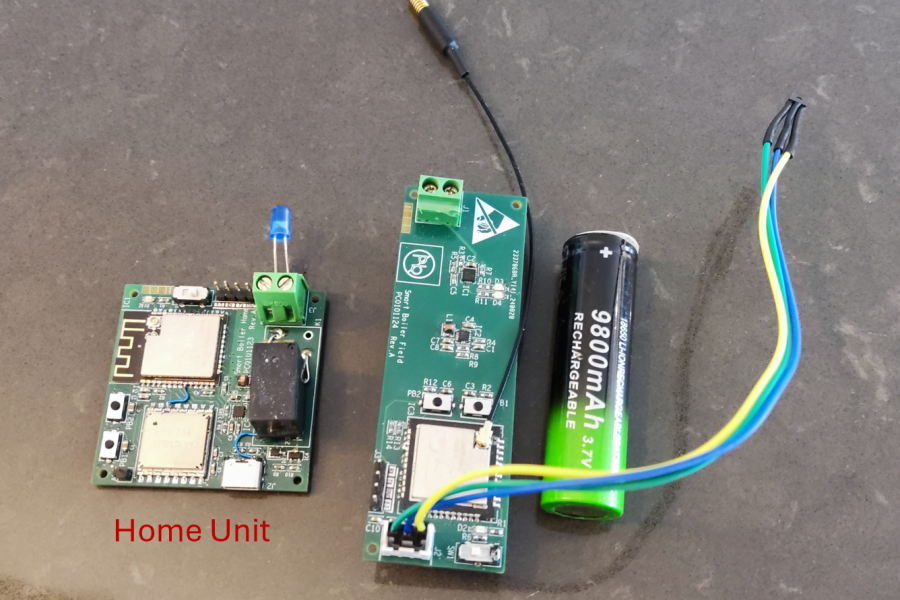
The Smart Boiler project addresses the everyday challenge of managing hot water availability and energy efficiency in households. Traditional water heating systems often leave users facing either cold showers or wasted electricity from unnecessary heating. Our solution introduces a smarter approach with two main components: a field unit installed next to the boiler and a home unit located inside the house, with both communicating over LoRa. The field unit, built around the CubeCell AM02 microcontroller and TSIC 301 temperature sensor, positions its temperature probe in parallel with the boiler’s thermostat to monitor heating conditions precisely. It is powered by a rechargeable battery to enable continuous operation. When the boiler is turned on, the field unit recharges its battery from the boiler’s supply line, allowing it to run non-stop. The home unit, based on an ESP32, replaces or connects in parallel to the traditional boiler switch and is powered from the household mains. It provides an intuitive web interface that displays water temperature, boiler status, and allows remote control, offering a user-friendly experience.
A central innovation of this project lies in its predictive capabilities. The heating time predictor, implemented with machine learning, estimates how long it will take the boiler to reach the desired temperature, preventing uncertainty and helping users plan their showers. The usage predictor forecasts when the next shower is expected by analyzing historical shower times from previous weeks. By combining these predictors, the system can anticipate demand, reduce wasted energy, and ensure hot water is ready when needed. The design also emphasizes low-power handling in the field unit, reliable LoRa communication, and adapting to the environment and the user’s needs, bridging the gap from prototype to a practical product. Overall, the Smart Boiler demonstrates how embedded hardware, wireless communication, and predictive intelligence can be combined to deliver a household utility that is efficient, reliable, and significantly more convenient for everyday use.