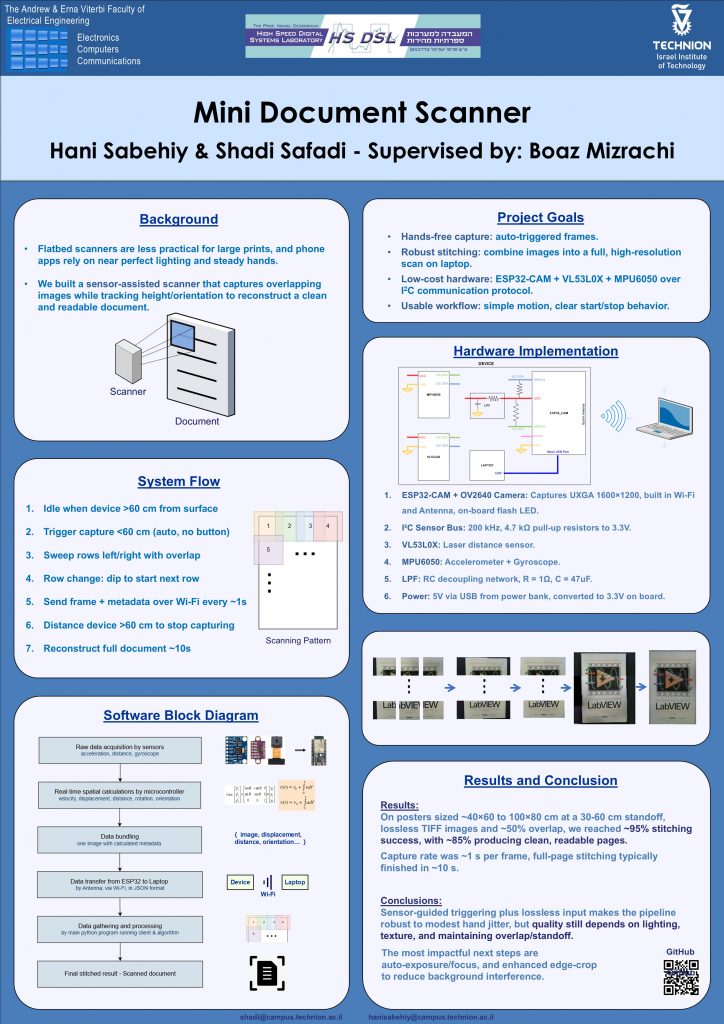
Hand-held, sensor-guided mini document scanner that digitizes documents. An ESP32-CAM with distance and motion sensors captures overlapping images and streams them to a host computer, which reconstructs them into a single stitched document.
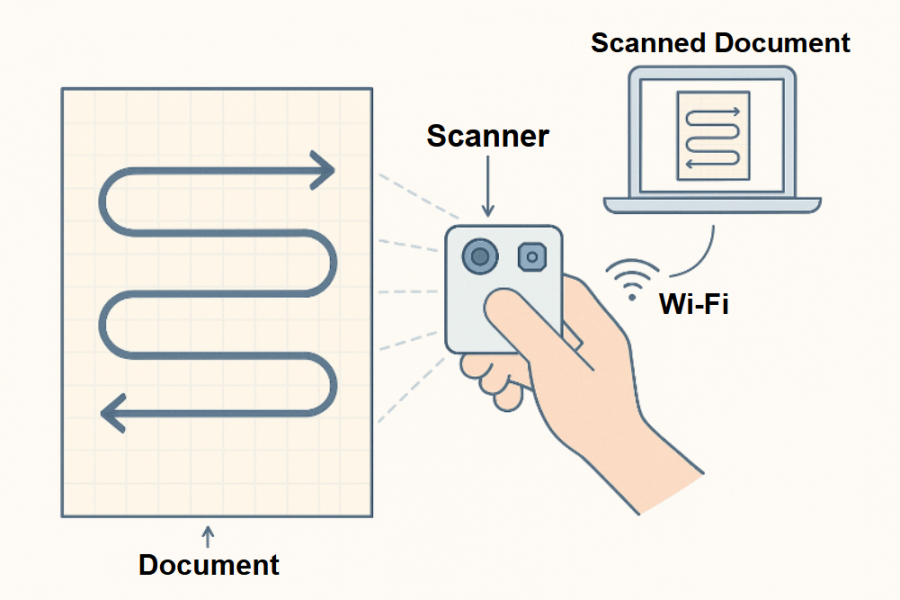
The project develops a compact, hand-held mini scanner that digitizes documents and large posters while the user moves in a planned back and forth motion in front of it. The device is built around an ESP32-CAM module, combined with a distance sensor and an inertial measurement unit, so it can sense how far it is from the page and how it is moving. Using this information, the system guides the scan along a simple serpentine pattern, capturing overlapping images in horizontal rows over the entire document.
During the scanning process, each of the captured images is sent over Wi-Fi to a laptop together with synchronized distance and motion data. On the computer side, a Python and OpenCV pipeline acting as a client, filters the sensor readings, uses feature-based matching to align adjacent views, and stitches all frames into a single, readable image of the full page. The prototype targets a working distance of roughly 30–60 cm and reconstructs a typical poster in around ten seconds. Tests on several poster sizes show a high rate of successful stitching and visually accurate reconstructions, indicating that sensor-guided, hand-held scanning is a practical alternative to a flatbed scanner for many lab and office scenarios.