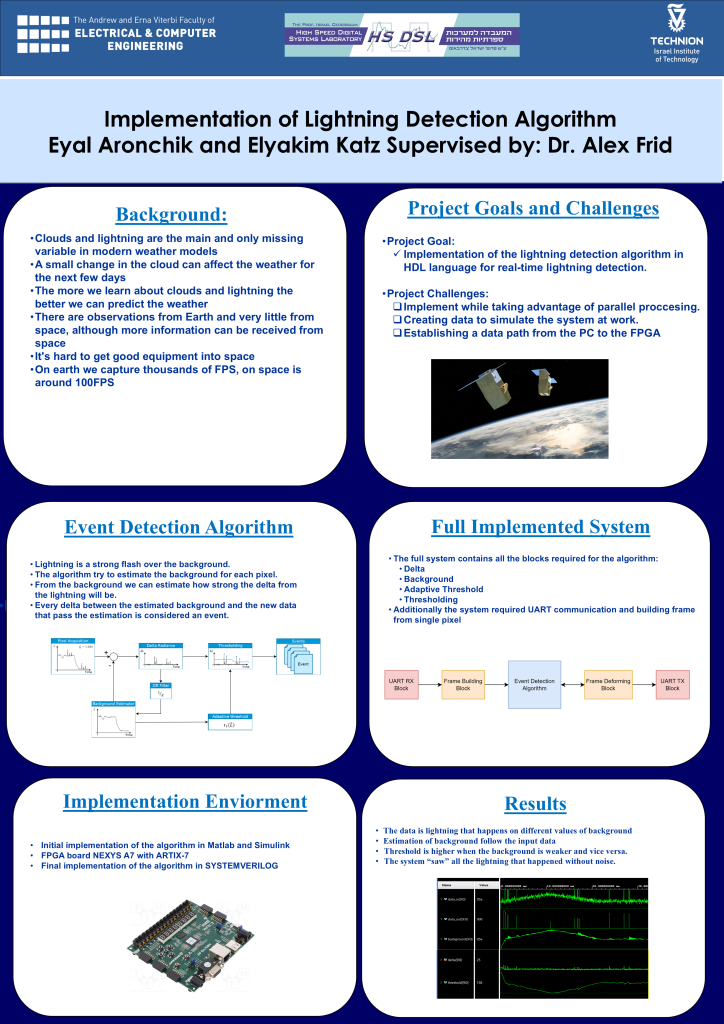
Implementation of FPGA-based Real-time event detection as part of lightning detection algorithm for space-borne observations, in pursue of developing a better forecast model.
This project focused on implementing a lightning detection algorithm for satellite meteorology, designed to identify true lightning events while filtering out noise and other transient disturbances.
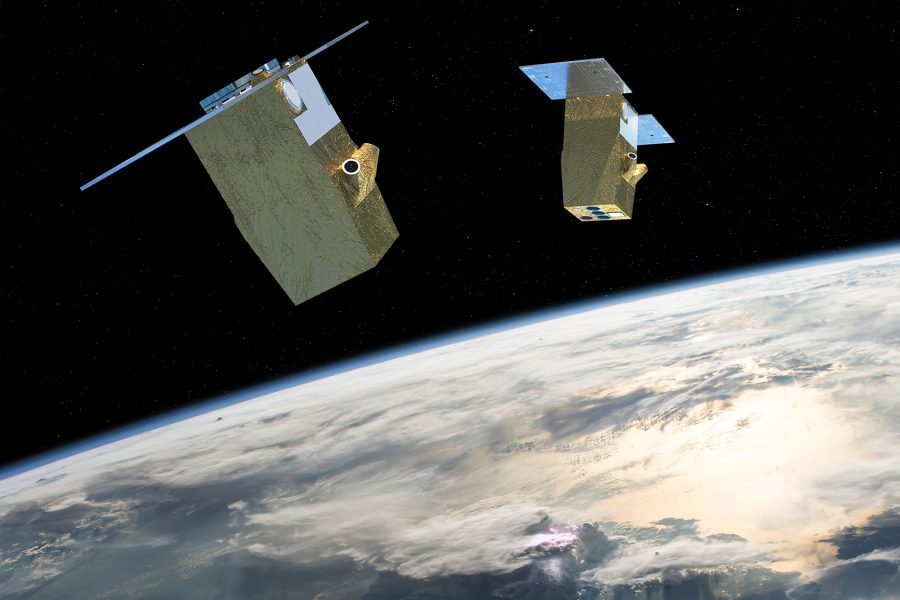
Detecting lightning events from space is crucial for enhancing severe weather monitoring and forecasting, but it poses challenges due to the interference from sensor noise, lighting variations, and satellite jitter. The adaptive threshold and filtering techniques developed in this project aimed to address these challenges by dynamically adjusting sensitivity based on the observed background radiance. This flexibility allows the algorithm to operate effectively during both bright daytime conditions and low-light nighttime scenarios.
The project was conducted in two main stages. First, the lightning detection algorithm was modeled in Simulink, allowing for early validation and tuning of key parameters. The Real-Time Event Processor (RTEP), adaptive threshold, and multiple filtering blocks were tested and optimized for accuracy. In the second stage, the algorithm was implemented in SystemVerilog to enable real-time operation on an FPGA. This involved translating high-level blocks into efficient, low-level hardware constructs, ensuring that the adaptive threshold adjusted dynamically based on incoming radiance data while meeting the FPGA’s timing and resource constraints.
The FPGA implementation successfully processed high-speed data streams in real-time, accurately detecting true lightning events while minimizing false positives.
Due to the big data that needed to be burned to the FPGA, a UART communication was established to transfer the data from matlab to the FPGA.