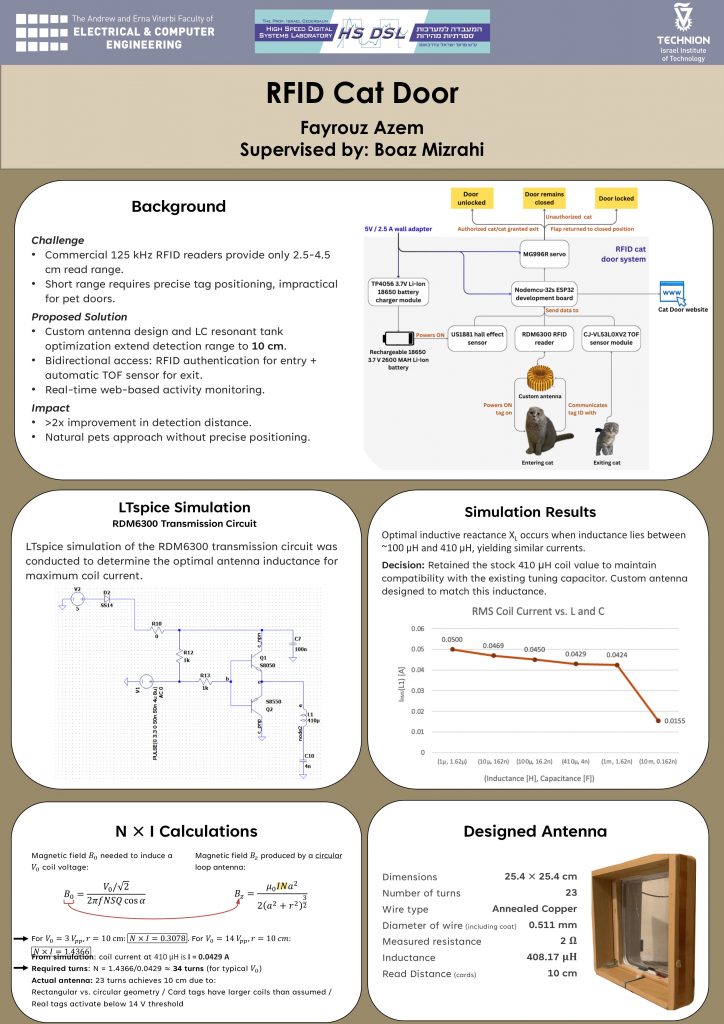
The RFID Cat Door project presents an ESP32-based smart cat door that uses 125 kHz RFID technology to grant entry only to authorized pets wearing EM4100-compatible tags. By designing a custom 25.4 × 25.4 cm antenna and optimizing the LC resonant tank, the system achieves a 10 cm read range, significantly extending the 2.5-4 cm range of commercial LF RFID readers. The door automatically unlocks for tagged cats entering and uses a time-of-flight sensor to allow untagged exit from inside.
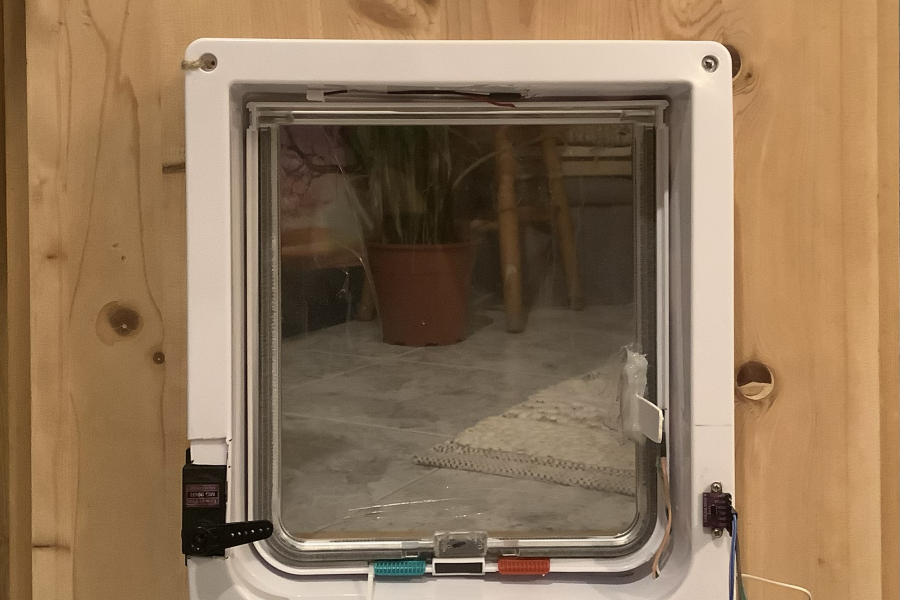
The RFID Cat Door project demonstrates a selective-access pet door system utilizing low-frequency (125 kHz) RFID tag authentication to control entry while permitting unrestricted exit. The system integrates an ESP32 microcontroller with an RDM6300 RFID reader, custom-designed antenna, MG996R servo actuator, VL53L0X time-of-flight sensor, and US1881 Hall-effect sensor for position feedback.
The primary engineering challenge addressed is the limited read range of commercial LF RFID systems, typically 2.5-4 cm. Through reverse-engineering the RDM6300 reader circuitry, conducting LTspice simulations of the resonant LC tank, and applying electromagnetic field theory, a custom 23-turn rectangular antenna was designed to achieve a practical read range of 10 cm for card-style EM4100 tags. The antenna maintains the stock 410 μH inductance to preserve compatibility with the reader’s existing tuning capacitor while using 24 AWG annealed copper wire in a 25.4 × 25.4 cm square configuration.
The system architecture implements bidirectional access control: authenticated entry requires valid RFID tag detection, while exit is automatic via the indoor-mounted TOF sensor detecting approaching pets. The servo-driven latch mechanism responds to both authentication modes, with Hall-effect feedback confirming door position. Power management utilizes a TP4056-managed Li-ion battery for the Hall sensor while maintaining separate 5V rails for the RFID reader and servo to prevent supply noise interference.
A React-based web dashboard hosted on Netlify provides real-time activity monitoring by polling event data from Adafruit IO, where the ESP32 posts entry, exit, and unauthorized access attempts. The complete implementation includes detailed Fusion 360 mechanical models, Fritzing wiring diagrams, and comprehensive documentation of component specifications, antenna design equations, and troubleshooting solutions for common implementation challenges.