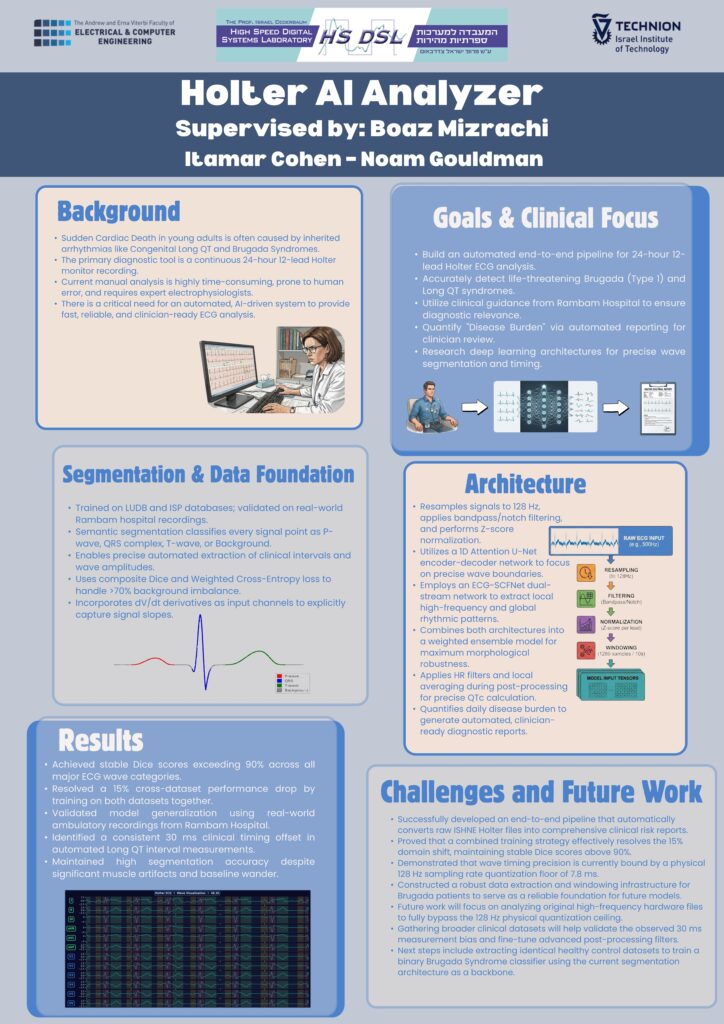
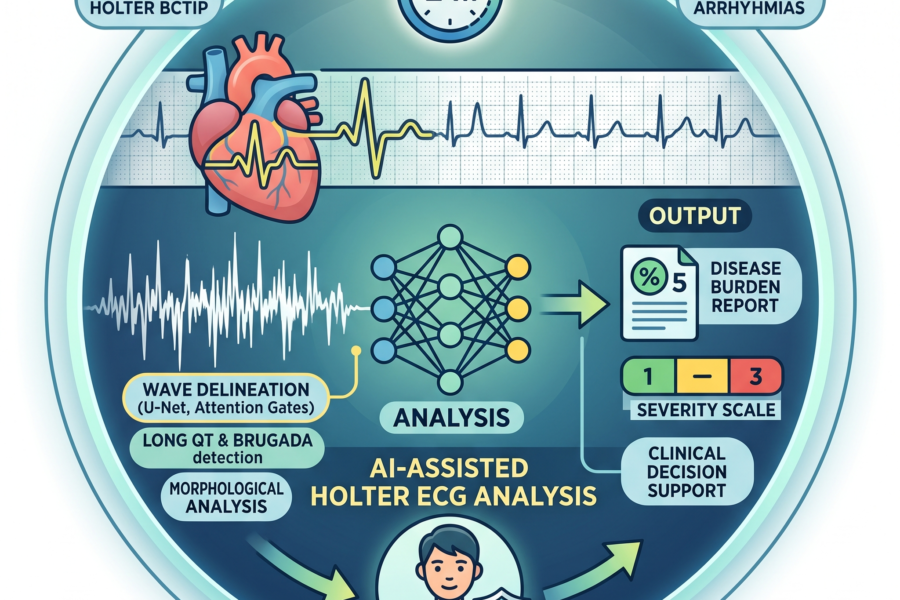
The project presents a deep-learning system for the automated analysis of 24-hour Holter ECG recordings, supporting early diagnosis of inherited arrhythmia syndromes that can cause sudden cardiac death in young people. Focusing on Congenital Long QT Syndrome and Brugada Syndrome, it performs automatic wave delineation and morphological analysis and produces a quantitative Disease Burden report to assist clinical decision-making.
Sudden cardiac death among young people is often preventable through early diagnosis of inherited arrhythmias, most notably Congenital Long QT Syndrome and Brugada Syndrome, which are diagnosed using continuous 24-hour, 12-lead Holter monitoring. Manual interpretation, however, is slow, demands specialized electrophysiologist expertise, is prone to human error, and cannot reliably quantify the spontaneous disease burden across tens of thousands of beats.
To address this, the project introduces a deep-learning system of two computational models. The raw signal is cleaned through Notch and Band-pass filters and a Discrete Wavelet Transform, resampled to a unified rate, and normalized per channel (Z-score), then segmented into 10-second windows. For Long QT detection, two parallel networks — a U-Net with Attention Gates and an ECG-SCFNet Dual-Stream model — are merged into a robust Ensemble, while a stability filter rejects measurements over noisy or unstable regions.
Evaluated on public and clinical datasets (LUDB and ISP), the Ensemble achieved a Mean Dice of 90.67% at 128 Hz and 91.72% at 500 Hz, with a QT MAE of ~20 ms and 14.04 ms respectively. On real Holter recordings, a systematic bias of roughly 30 ms was found in T-wave end estimation, traced to the hardware quantization limit (about 7.8 ms per sample at 128 Hz).
In deployment, the system produces a comprehensive report of the total daily disease burden, translated into a 1–3 severity scale to guide monitoring or intervention decisions. Overall, the project demonstrates the full technical feasibility of an automated tool that streamlines Holter interpretation, improves diagnostic consistency, and contributes to preventing sudden cardiac death.