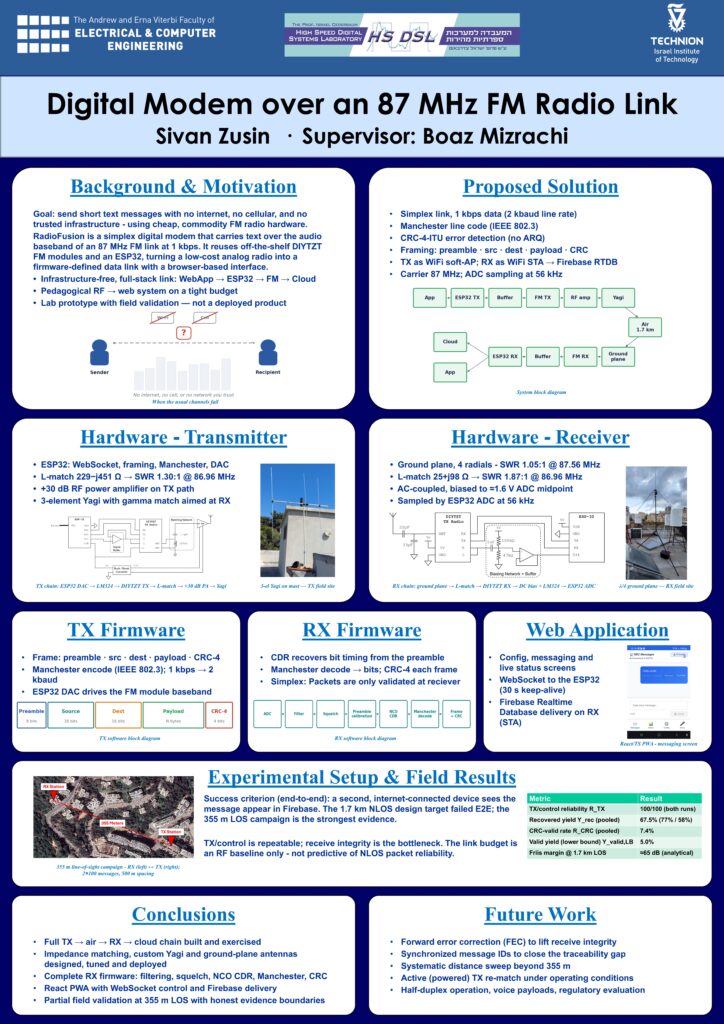
This project is a simplex digital modem that carries text messages over the audio baseband of an 87 MHz FM radio link at 1 kbps, using commodity DIYTZT FM modules and ESP32 microcontrollers. The project delivers a complete, infrastructure-free stack - a React web application, custom RF front ends and antennas, and receiver firmware for clock recovery and decoding - with cloud delivery of received messages and field validation over a 355 m line-of-sight link.
This project is a simplex digital modem that transmits short text messages over the audio baseband of an 87 MHz FM radio link at a data rate of 1 kbps (2 kbaud line rate). The project explores whether a low-cost, firmware-defined data link can be built from commodity analog radio hardware, enabling communication with no internet, no cellular network, and no trusted infrastructure. It is developed as an educational, end-to-end RF-to-web system rather than a deployed product.
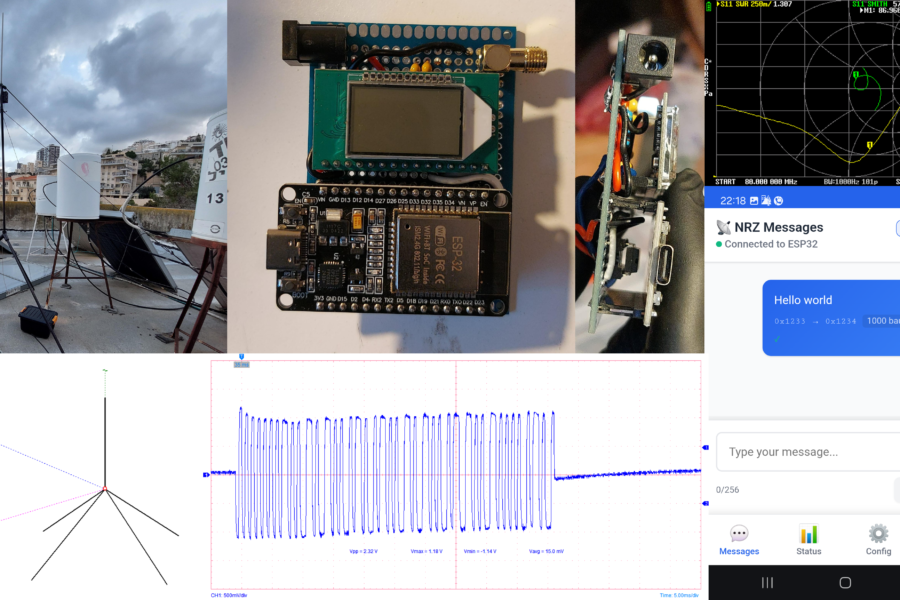
The system is built around two ESP32-based units, each paired with an off-the-shelf DIYTZT FM stereo module. On the transmit side, the ESP32 frames each message with a preamble, source and destination addresses, and a CRC-4-ITU checksum, applies Manchester line coding (IEEE 802.3), and generates the analog baseband signal through its digital-to-analog converter. The signal is buffered by an LM324 op-amp, FM-modulated by the DIYTZT module, and driven to a custom three-element Yagi antenna through an L-section impedance-matching network and a 30 dB RF power amplifier. On the receive side, a quarter-wave ground-plane antenna feeds a matched DIYTZT receiver, whose demodulated audio is conditioned and sampled by the ESP32 analog-to-digital converter at 56 kHz. The receiver firmware performs filtering, squelch, numerically-controlled-oscillator clock-and-data recovery, Manchester decoding, and CRC validation.
A central component of the project is a React and TypeScript progressive web application that provides device configuration, real-time messaging, and live link-status monitoring. The application communicates with the transmitter over a WebSocket link (the ESP32 acting as a WiFi access point), while the receiver operates as a WiFi station and forwards decoded messages to a Firebase Realtime Database, allowing any internet-connected device to observe received traffic in the cloud.
The complete transmit-to-air-to-receive-to-cloud chain was implemented and exercised in the field. The original design target was 1.7 km non-line-of-sight operation; while a free-space link budget indicates ample analytical margin, the end-to-end success criterion was not met at that range. The strongest measured evidence comes from a 355 m line-of-sight campaign, in which transmit-side control was fully repeatable and a pooled recovered message yield of 67.5% was achieved, identifying receive-side integrity as the primary bottleneck. The work concludes with a candid separation between analytical feasibility and demonstrated field reliability, and proposes forward error correction, synchronized message identifiers, and a systematic distance sweep as future improvements.