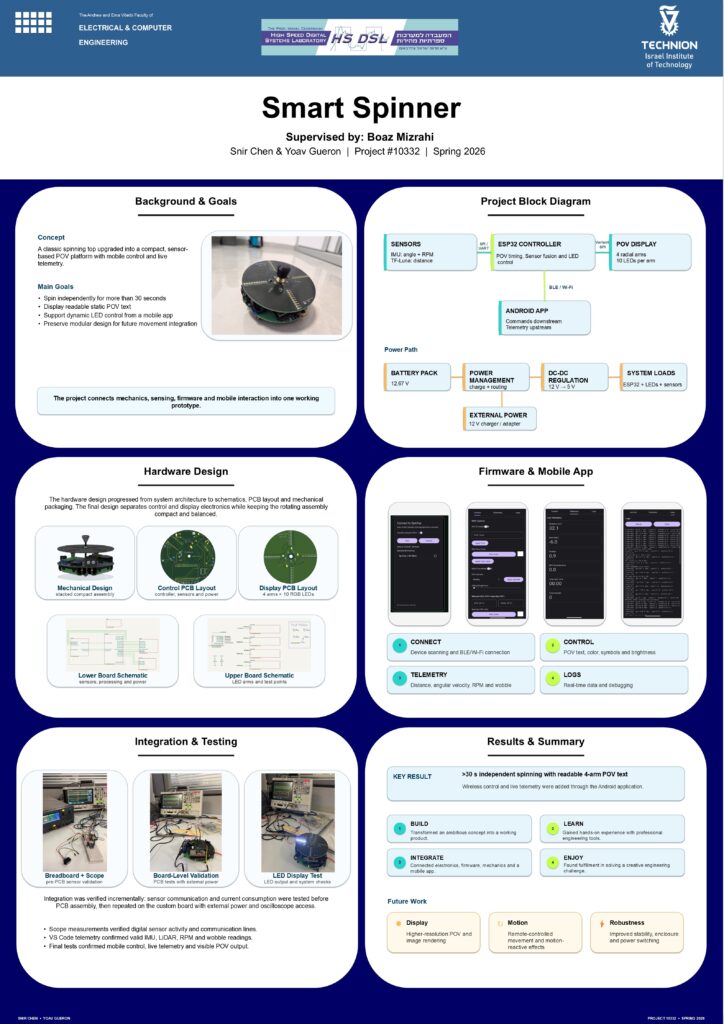
The Smart Spinner project developed a compact, sensor-based persistence-of-vision spinning top that combines mechanical rotation, embedded sensing, RGB LED visualization, wireless control, and live telemetry. The final prototype demonstrates more than 30 seconds of independent spinning while displaying POV text through a four-arm RGB LED array controlled by an Android application.
The Smart Spinner project developed an interactive persistence-of-vision spinning top that upgrades a classic mechanical toy into a compact embedded system. The system combines mechanical rotation, custom electronic integration, inertial sensing, LiDAR distance measurement, RGB LED visualization, wireless communication, embedded firmware, and an Android control application. By synchronizing LED activation with the angular motion of the spinning top, the prototype creates visible text and visual effects during rotation while remaining battery-powered and mechanically compact.
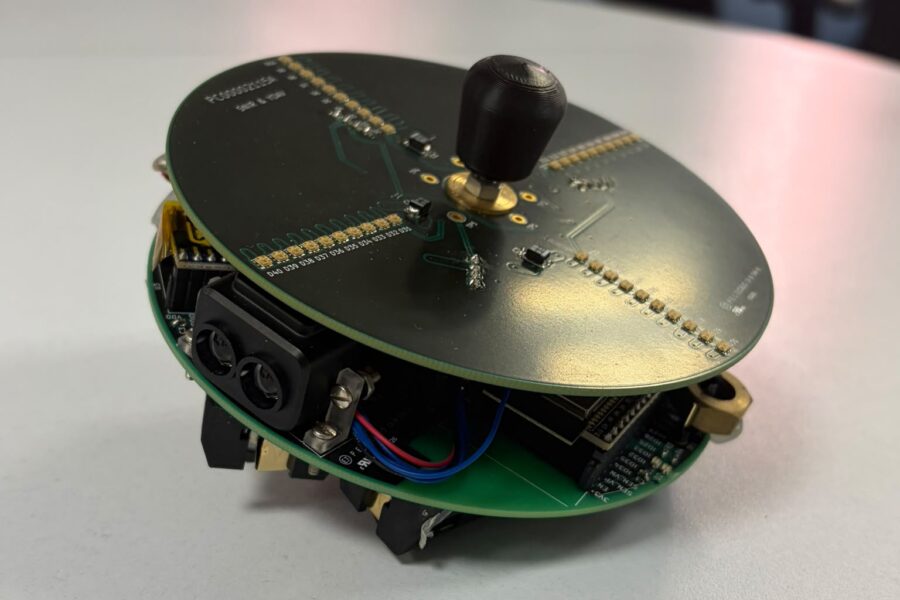
The final prototype includes two custom PCBs, an ESP32-based controller, an IMU for angular-rate and motion sensing, a TF-Luna LiDAR sensor for distance-based reference detection, and a four-arm RGB LED array with ten LEDs per arm. The Android application enables wireless configuration of the displayed text, symbol, color, and brightness, and also provides live telemetry such as RPM, distance, gyroscope readings, wobble indication, and system logs. This two-way communication transforms the device from a static electronic toy into an interactive platform that can be configured, monitored, and debugged in real time.
The project achieved its main functional goals by demonstrating independent spinning operation for more than 30 seconds while displaying static POV text. It also preserved a modular mechanical architecture for future controlled-movement integration and added dynamic remote-control capabilities through the mobile application. Additional engineering improvements included size reduction to a compact 12 cm diameter, transition to a two-PCB architecture, expansion to a four-arm display system with 40 RGB LEDs, improved high-speed motion sensing, and a regulated battery-powered supply.
The main engineering contribution of the project is the integration of multiple disciplines into one functional product. Mechanical design, PCB design, embedded firmware, sensor communication, power regulation, POV rendering, and mobile-app development were combined into a working prototype. The resulting system provides a practical foundation for future extensions, including higher-resolution displays, advanced image rendering, motion-reactive effects, improved mechanical stability, and remote-controlled movement.