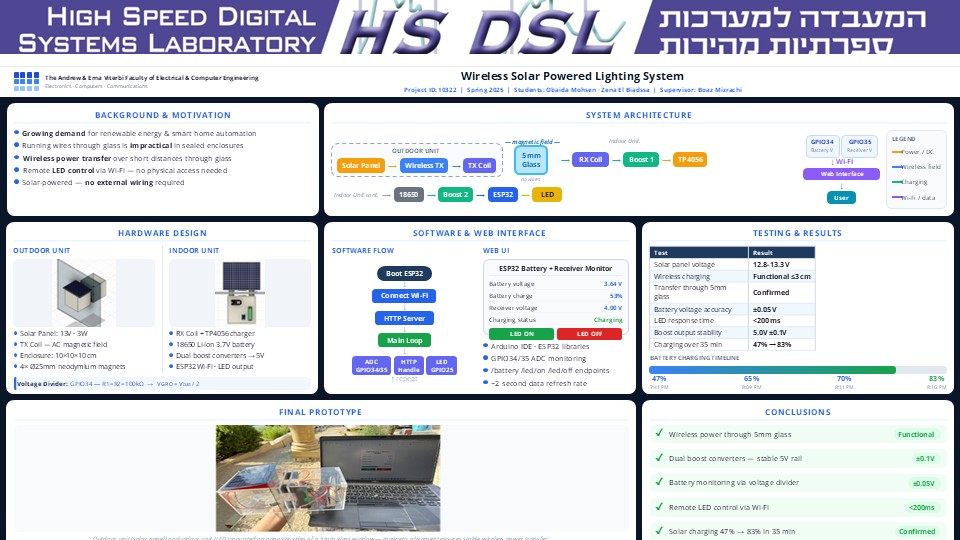
This project presents a wireless solar-powered lighting system capable of transferring energy through a
glass barrier using inductive wireless power transfer. The system integrates solar energy harvesting,
battery charging, ESP32-based monitoring, and remote LED control through a Wi-Fi web interface.
This project presents the design and implementation of a wireless solar-powered lighting system capable
of transferring electrical energy through a glass barrier using inductive wireless power transfer. The
system combines renewable energy harvesting, wireless energy transmission, embedded monitoring, and
remote lighting control into a single integrated platform.
The outdoor subsystem consists of a solar panel connected to a wireless transmitter module and
transmitter coil. Electrical energy generated by the solar panel is converted into a high-frequency
magnetic field and transferred wirelessly through the glass barrier using inductive coupling. On the indoor
side, a receiver coil captures the transmitted energy and delivers it to a wireless receiver module and
battery charging subsystem.
The indoor subsystem includes a TP4056 lithium-ion charging module, an 18650 rechargeable battery, a
boost-converter stage, an ESP32 microcontroller, and an LED lighting system. The ESP32 continuously
monitors both battery voltage and receiver voltage using ADC inputs and voltage-divider circuits. The
monitored data is processed and displayed through a Wi-Fi web interface, allowing real-time monitoring
of battery status, charging activity, and remote LED ON/OFF control from a browser connected to the
same local network.
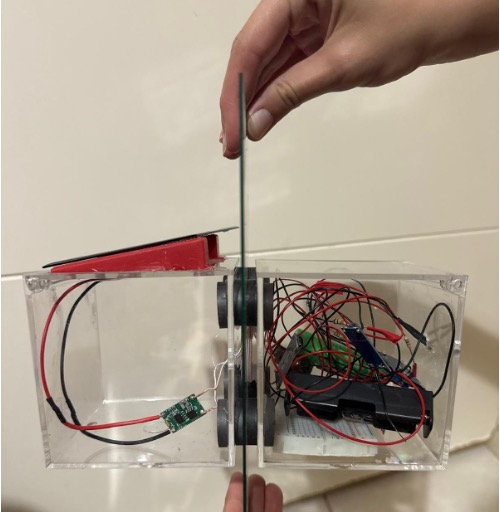
The project also includes mechanical enclosure design and magnetic alignment mechanisms to stabilize
the indoor and outdoor units across the glass barrier. Several engineering challenges were addressed
during development, including ADC voltage scaling, wireless transfer efficiency, Wi-Fi stability, and coil
alignment optimization.
Experimental testing demonstrated successful wireless energy transfer, stable battery charging, real-time
voltage monitoring, and reliable remote LED control. The final prototype validates the feasibility of
integrating solar energy harvesting, wireless power transfer, and embedded monitoring technologies into a
practical wireless lighting system without physical electrical wiring through glass.