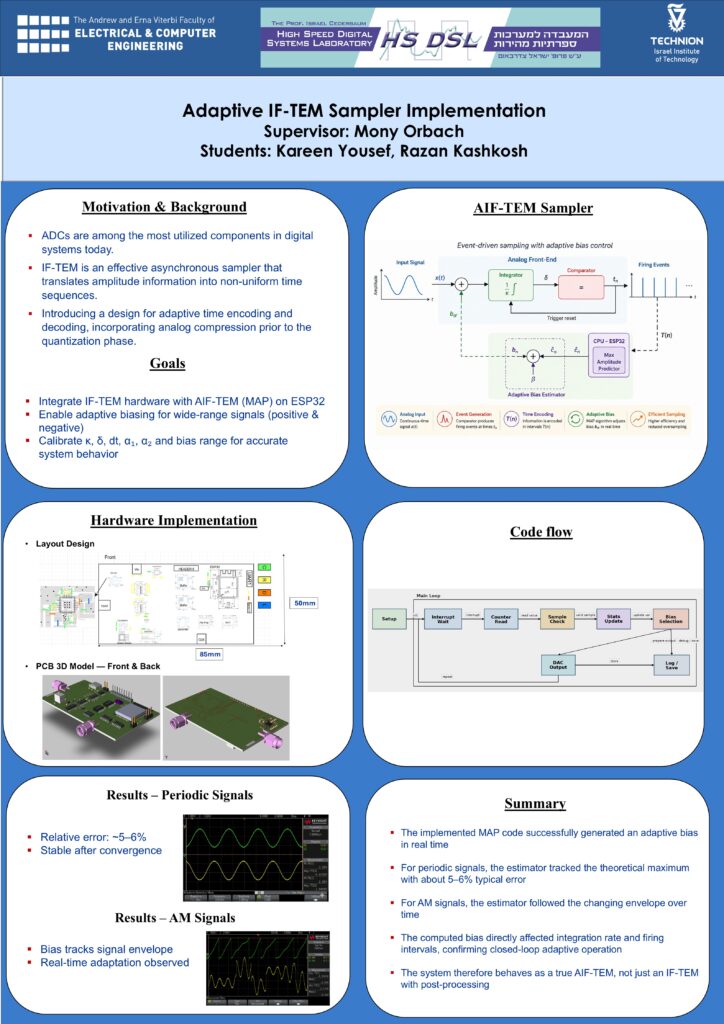
This project presents the implementation of an adaptive asynchronous analog-to-digital converter based on the TEM-AIF architecture.
By incorporating a real-time adaptive bias algorithm (MAP), the system improves sampling efficiency and reduces oversampling compared to traditional synchronous methods.
This project focuses on the design and implementation of an adaptive asynchronous sampling system based on the Integrate-and-Fire Time Encoding Machine (TEM-IF) architecture and its adaptive extension, TEM-AIF. Unlike conventional synchronous analog-to-digital converters (ADCs), which rely on fixed-rate sampling dictated by the Nyquist criterion, the proposed system performs sampling based on the signal’s behavior, allowing for more efficient use of computational and energy resources.
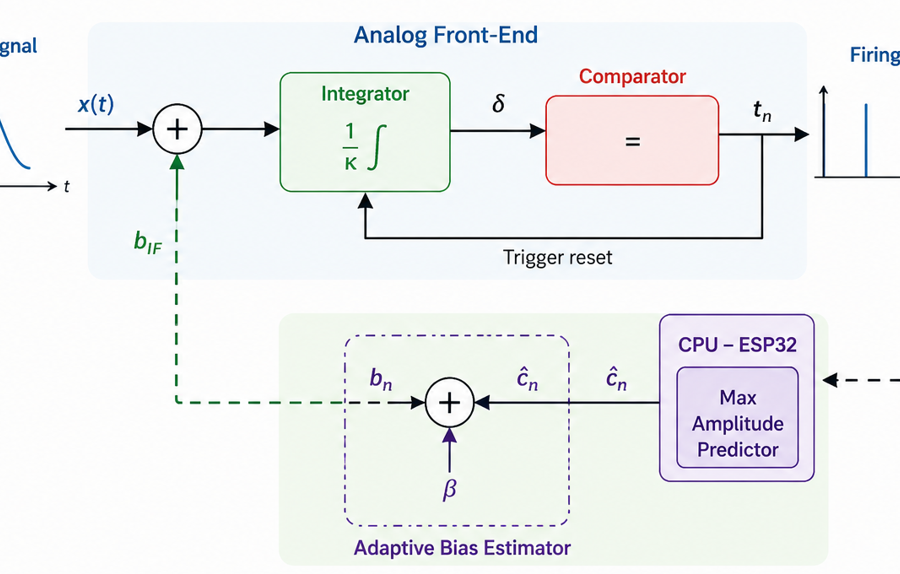
The work builds upon previous implementations of a basic TEM-IF system and extends it by integrating an adaptive bias mechanism using a MAP (Max Amplitude Predictor) algorithm. In classical TEM-IF systems, a fixed bias is added to the input signal to ensure proper integrator operation; however, this introduces a trade-off between stability and efficiency. A bias that is too high leads to excessive sampling (oversampling), while a bias that is too low may compromise system functionality. To address this limitation, the current project implements a real-time adaptive bias algorithm that dynamically adjusts the bias based on the time intervals between consecutive firing events.
The system combines analog hardware (integrator, comparator, and reset mechanism) with a digital control unit implemented on an ESP32 microcontroller. The digital component processes interrupt signals generated by the analog front-end, computes time intervals, and applies the MAP algorithm to estimate signal characteristics and update the bias accordingly. The updated bias is quantized and fed back into the analog system via a DAC, forming a closed feedback loop.
Experimental validation was conducted using periodic and amplitude-modulated (AM) input signals. The results demonstrate that the adaptive algorithm successfully tracks the local maxima of the input signal and adjusts the bias dynamically, maintaining system stability while reducing unnecessary sampling. Compared to fixed-bias systems, the adaptive approach shows improved flexibility, efficiency, and robustness across a wider range of signal conditions.
In conclusion, this project demonstrates a practical and effective implementation of an adaptive asynchronous sampling system, highlighting the advantages of combining event-based sampling with real-time adaptive algorithms for modern signal processing applications.