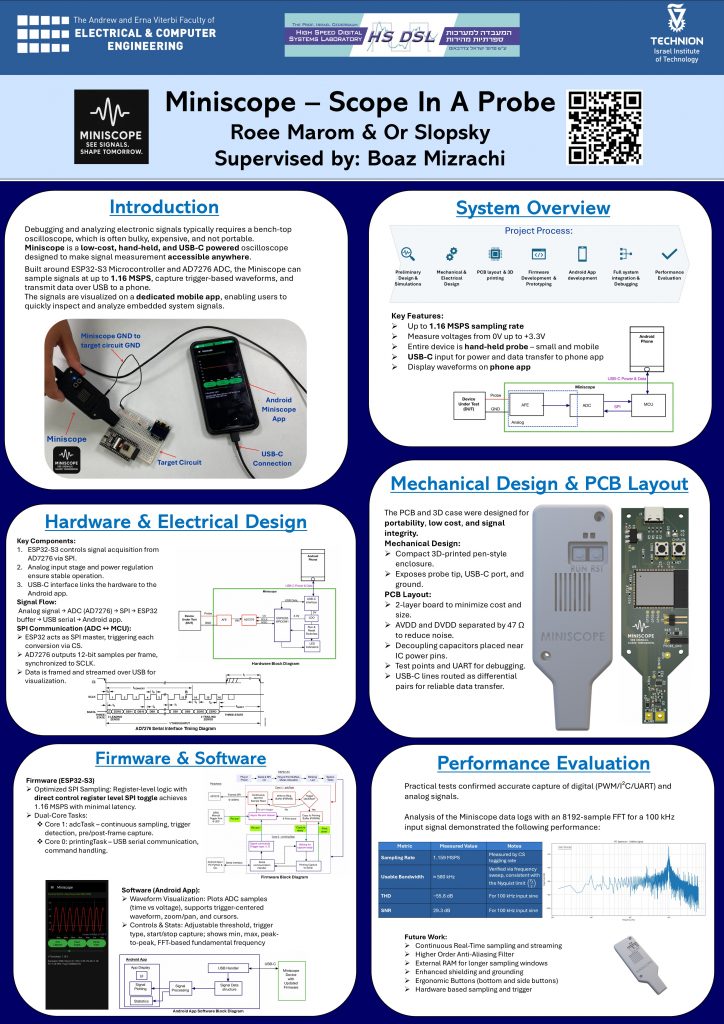
A low-cost, hand-held, and easy-to-use oscilloscope capable of acquiring different signals of a typical microcontroller system, with waveform visualization displayed directly on an Android phone.
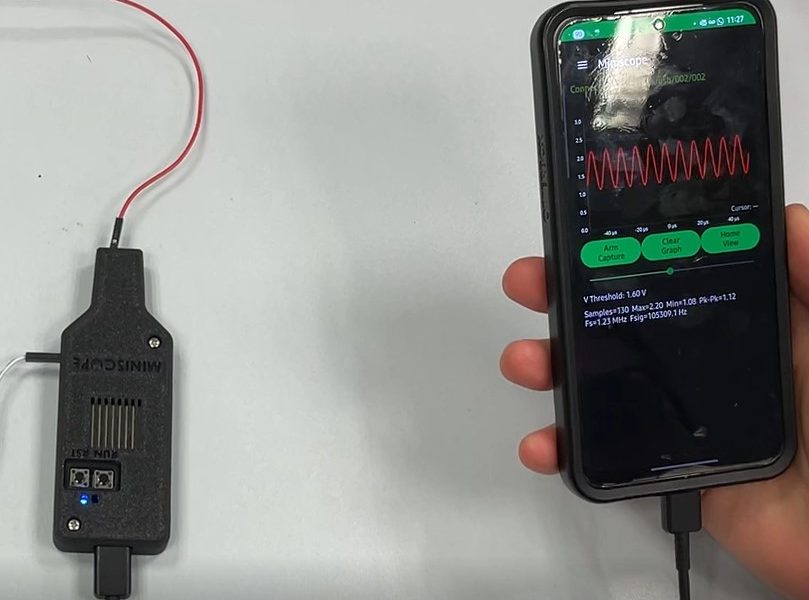
The Miniscope project introduces a compact, open-source, and hand-held oscilloscope designed to provide a low-cost and mobile solution for real-time signal acquisition and visualization. Built around the ESP32-S3-WROOM1-N16R8 microcontroller and the AD7276 high-speed ADC, the device achieves sampling rates of up to 1.16 MSPS, enabling accurate measurement of analog signals between 0V and +3.3V. All acquired data is transmitted via serial interface over USB-C, which serves both as the power source and communication link to an Android smartphone running a dedicated companion app.
The hardware was designed for simplicity and portability, forming an all-in-one hand-held probe that combines the ADC, microcontroller, and USB interface in a compact enclosure. On the software side, the Android application—developed in Java using Android Studio—provides a clean and responsive interface for waveform visualization, trigger control, and threshold adjustment. The app supports interactive waveform display, adjustable triggering modes, and voltage threshold configuration, allowing users to analyze common embedded signals directly from their mobile device.
The Miniscope system successfully demonstrated the ability to acquire and display typical signals found in microcontroller environments, including PWM, sinusoidal, and I²C digital waveforms. The overall architecture emphasizes modularity and transparency, with well-documented firmware and open-source design files supporting further customization and experimentation.
This project demonstrates complete end-to-end development—from electronic design and firmware implementation to Android application development—resulting in a self-contained and educational measurement tool.
Future Work
Future enhancements will focus on noise reduction, higher-order anti-aliasing filters, and DMA-enabled continuous real-time sampling using improved ADC or MCU components. Additional goals include adding AC/DC coupling, hardware triggering, ping-pong buffers for seamless data flow, and ergonomic side and bottom buttons for easier operation.